Turmeric vs curcumin: What is the difference and what does science really say?
Turmeric and curcumin are often treated online as if they are identical. In reality, they are closely related but fundamentally different. Understanding this distinction is essential because the potential benefits, limitations and safety concerns depend heavily on whether someone is consuming ordinary culinary turmeric or concentrated curcumin supplements.
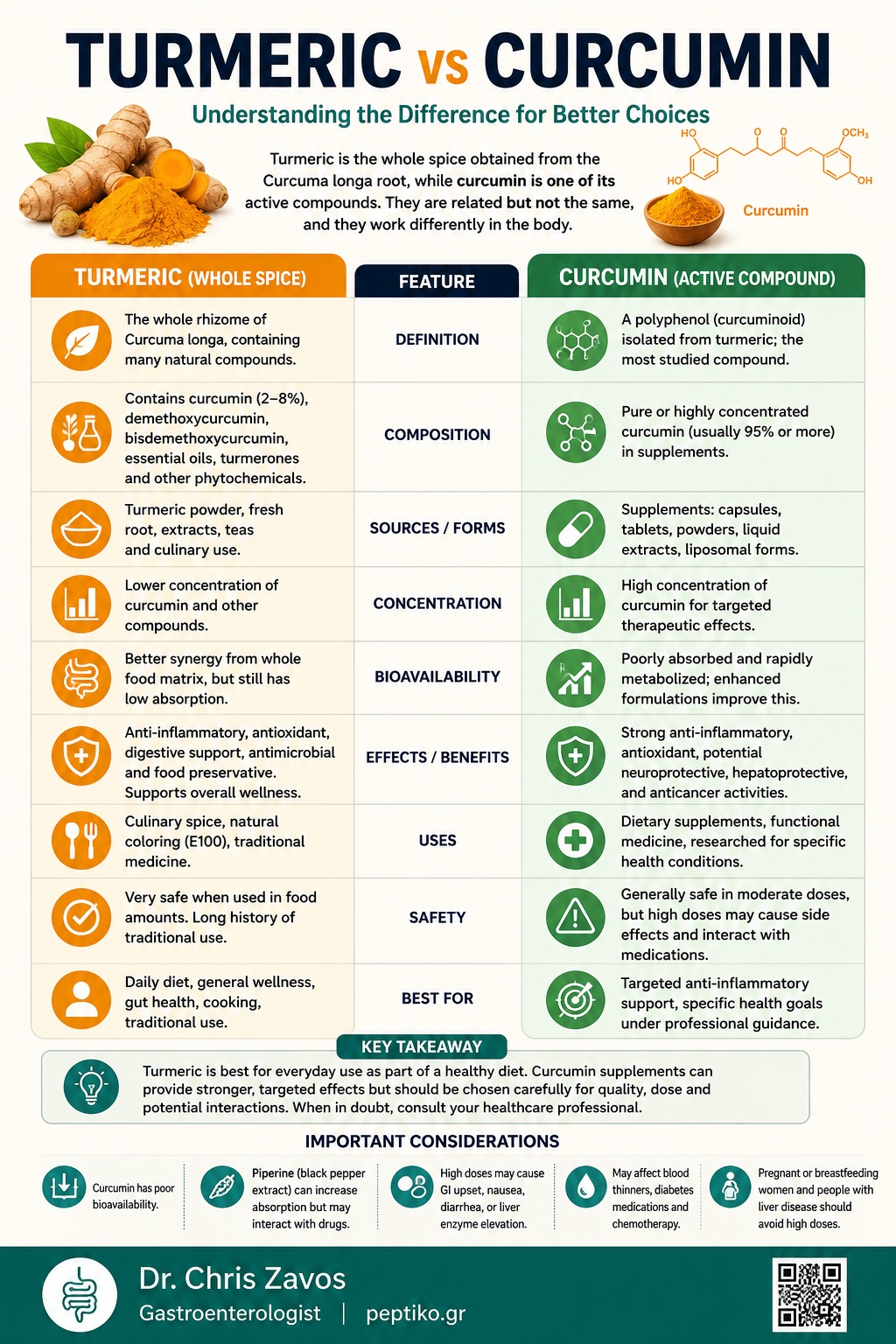
Turmeric is the whole yellow-orange spice obtained from the rhizome of Curcuma longa. Curcumin is one of turmeric’s major active compounds and the most extensively studied curcuminoid.
Modern scientific interest exploded after laboratory studies suggested antioxidant, anti-inflammatory, neuroprotective and anticancer properties. However, researchers have also raised major concerns involving poor bioavailability, exaggerated therapeutic claims and possible adverse effects at high doses. This article explores turmeric vs curcumin for inflammation, turmeric or curcumin which is better, curcumin vs turmeric for cancer, curcumin or turmeric for joint pain, curcumin or turmeric for weight loss, whether you can take turmeric and curcumin together, and whether you can buy curcumin without turmeric.
What is turmeric?
Turmeric is a whole spice used for centuries in Asian cuisine and traditional medicine. Besides curcumin, it contains multiple other compounds including demethoxycurcumin, bisdemethoxycurcumin, volatile oils and turmerones. Historically, turmeric has been used for digestive complaints, wound healing and inflammatory conditions. It is also widely used as a food coloring and preservative. In Europe, curcumin extracted from turmeric is approved as food additive E100. One important point often ignored online is that ordinary turmeric powder contains relatively small amounts of curcumin compared with concentrated supplements.
What is curcumin?
Curcumin is a polyphenolic molecule isolated from turmeric. Chemically known as diferuloylmethane, it is responsible for much of turmeric’s characteristic yellow color. Most modern supplements marketed for inflammation, antioxidant support or liver health contain concentrated curcumin extracts rather than simple turmeric powder. This matters because concentrated curcumin behaves much more like a pharmacologically active compound than a traditional culinary spice.
Turmeric vs curcumin for inflammation
One of the most common searches online is “turmeric vs curcumin for inflammation”. Curcumin is generally considered the stronger anti-inflammatory compound because it directly influences inflammatory pathways such as NF-kB, COX-2 and inflammatory cytokines. Experimental studies suggest that curcumin may reduce inflammatory mediators including TNF-alpha, IL-1 and IL-6. This explains why many curcumin supplements are marketed for chronic inflammatory conditions.
Turmeric itself may still have anti-inflammatory effects, partly because it contains curcumin along with additional phytochemicals that may work synergistically. However, the concentration of active curcuminoids is far lower than in standardized supplements. In practice, turmeric may be more appropriate for long-term dietary use, while concentrated curcumin supplements are often chosen when stronger anti-inflammatory activity is desired.
Curcumin or turmeric for joint pain
Another frequent question is “curcumin or turmeric for joint pain”. Research on osteoarthritis and joint discomfort generally focuses more on curcumin supplements than ordinary turmeric powder. Some clinical studies suggest curcumin may improve pain and stiffness in osteoarthritis, although results remain inconsistent and depend heavily on the formulation used. Bioavailability is a major issue because poorly absorbed products may produce weaker effects. Turmeric used in food may still contribute mild anti-inflammatory benefits, but concentrated curcumin is usually considered the more potent option for joint-related symptoms. That said, higher potency also means greater potential for interactions and side effects.
Curcumin or turmeric for weight loss
Many people search for “curcumin or turmeric for weight loss”, but the evidence here remains relatively weak. Curcumin may influence inflammatory pathways and metabolic signaling associated with obesity and insulin resistance. Some experimental studies suggest possible effects on fat accumulation and metabolic inflammation. However, human data remain limited and inconsistent. Neither turmeric nor curcumin should be viewed as a true weight-loss treatment. At best, they may modestly support metabolic health when combined with dietary improvement, exercise and overall lifestyle changes. Claims that turmeric “melts fat” or that curcumin causes major weight loss are not supported by strong clinical evidence.
Curcumin vs turmeric for cancer
Perhaps the most controversial topic is “curcumin vs turmeric for cancer”. Curcumin is one of the most heavily studied natural compounds in cancer biology. Laboratory studies show effects on apoptosis, angiogenesis, tumor proliferation and inflammatory signaling pathways. However, research strongly criticizes the tendency to overinterpret these findings. The scientists emphasize that most anticancer studies involve laboratory concentrations difficult or impossible to achieve in human tissues after oral supplementation.
Clinical trials in cancer patients have generally produced much less dramatic outcomes than laboratory experiments. This does not mean curcumin has no biological relevance. It means that statements such as “curcumin cures cancer” are scientifically irresponsible and unsupported. Turmeric itself has been studied far less extensively than isolated curcumin in oncology research.
Turmeric or curcumin: Which is better?
The answer to “turmeric or curcumin which is better” depends entirely on the goal. Turmeric is a whole-food spice with centuries of culinary use and a broader phytochemical profile. Curcumin is a concentrated compound with stronger pharmacologic activity but also more concerns regarding absorption, safety and interactions.
For general dietary use and long-term culinary consumption, turmeric may represent the more conservative and physiologic approach. For targeted anti-inflammatory supplementation, curcumin is usually considered more potent, especially in enhanced-bioavailability formulations. Neither should be viewed as a miracle therapy.
Can I take turmeric and curcumin together?
A common question is “can I take turmeric and curcumin together”? Technically, yes, because curcumin already originates from turmeric. Many supplements actually combine turmeric extracts with additional concentrated curcumin. However, combining multiple products may substantially increase total curcuminoid exposure. This becomes important because higher doses may increase the risk of gastrointestinal side effects, liver-related adverse events or medication interactions. Patients taking anticoagulants, chemotherapy, immunosuppressants or multiple medications should discuss supplementation with a physician before combining products.
Can you buy curcumin without turmeric?
Another common search is “can you buy curcumin without turmeric”? The answer is yes. Most commercial curcumin supplements contain isolated or highly concentrated curcuminoid extracts rather than ordinary turmeric powder. Some products are standardized to very high percentages of curcumin and may include absorption enhancers such as piperine. This distinction matters because isolated curcumin may behave very differently from culinary turmeric consumed in food.
The biggest scientific problem: poor bioavailability
One of the most important scientific limitations of curcumin is poor absorption. Recent research emphasizes that even after high oral doses, plasma concentrations often remain extremely low because curcumin is poorly absorbed and rapidly metabolized in the intestine and liver. This is one reason why many impressive laboratory findings have not translated into equally dramatic clinical outcomes. To overcome this issue, manufacturers developed enhanced formulations using piperine, liposomes, nanoparticles and phospholipid complexes. However, increasing absorption may also increase the risk of adverse effects and drug interactions.
Is curcumin completely safe?
Many people assume turmeric and curcumin are automatically harmless because turmeric is a traditional food ingredient. Reality is more nuanced. Short-term studies generally suggest reasonable tolerability at moderate doses, but side effects can occur, particularly with concentrated supplements. Reported adverse effects include nausea, diarrhea, bloating and elevated liver enzymes.
Scientists claim that there is experimental evidence involving DNA damage and chromosomal alterations under certain laboratory conditions and concentrations. However, these findings remain controversial, but they highlight why exaggerated statements such as “100% safe at any dose” are scientifically inaccurate.